
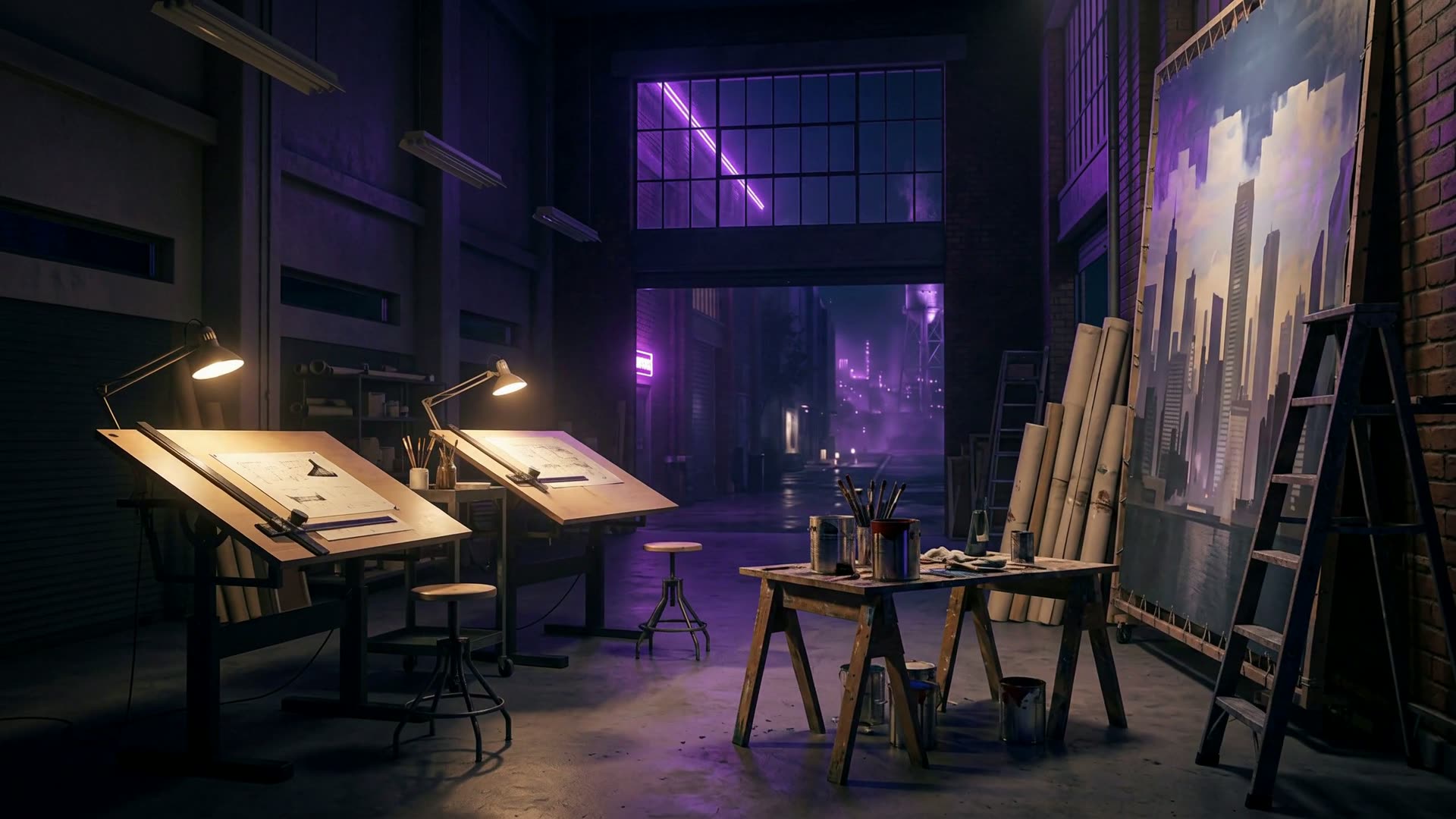
The drafting tables. Every studio owns tools. What sets one apart is which tools it has run through a real deadline, and how much of the bench it built itself.
The instruments
Moving image. MiniMax H3, Kling 3.0, Seedance 2.0 and 2.5, and Cinema Studio 4.0. We run them side by side on the same shot. That is the only way to learn which model can hold a particular move. This lot was shot on H3.
Stills and frames. Nano Banana Pro for building and fixing a frame, with GPT Image and Seedream where they are stronger, and Soul Cinema for cinematic plates. Each one is better at a particular job, and each one will quietly ruin another.
Voice and music. ElevenLabs and Fish Audio for narration and character voice, HeyGen for avatar work, and Suno for music. The track playing over the lot is our own.
Underneath. ffmpeg touches every frame and every decibel that leaves here. Whisper runs locally for transcription. Ollama, Groq and OpenRouter handle the routine drafting that does not need a paid model. Remotion, hosted by us, makes the motion graphics. Cloudflare delivers it all.
Built here
CutPilot is our own editor. Drop in a long recording and it finds and cuts the usable moments, then you edit by hand or simply tell it what to change. It renders on your own machine, with no watermark and no meter running while you work.
Around it sit about a hundred and sixty scripts and five purpose-built tools. They cover shot blocking, rotoscoping, lip sync checks, rendering, publishing and quality control. On top of that is a library of roughly sixty in-house workflows. Each one is a set way of doing a job we do often. It is why our fiftieth delivery is built to the same standard as our first.
That library is the real asset, and it stays in the building. Anyone can rent a model. What takes a year to learn is the order to do things in, which checks catch which problems, and what finished is allowed to mean.
The standard
Nothing ships simply because it looks about right. The drive you took to get here was measured. Frames on either side of a hidden cut line up to a fraction of a pixel, and sound across every join sits within a fifth of a decibel. Every frame you stop on was checked against the frame we approved.
That is the bar for anything that leaves this lot. It is why the work holds up at full size, on a good monitor, in front of a client. How that one was measured is on Soundstage 6.
A tool earns its spot by surviving a real deadline. Nothing on this page is here because it looked good in a demo.