
FREE DOWNLOAD
It's not your prompts. It's the missing workflow.
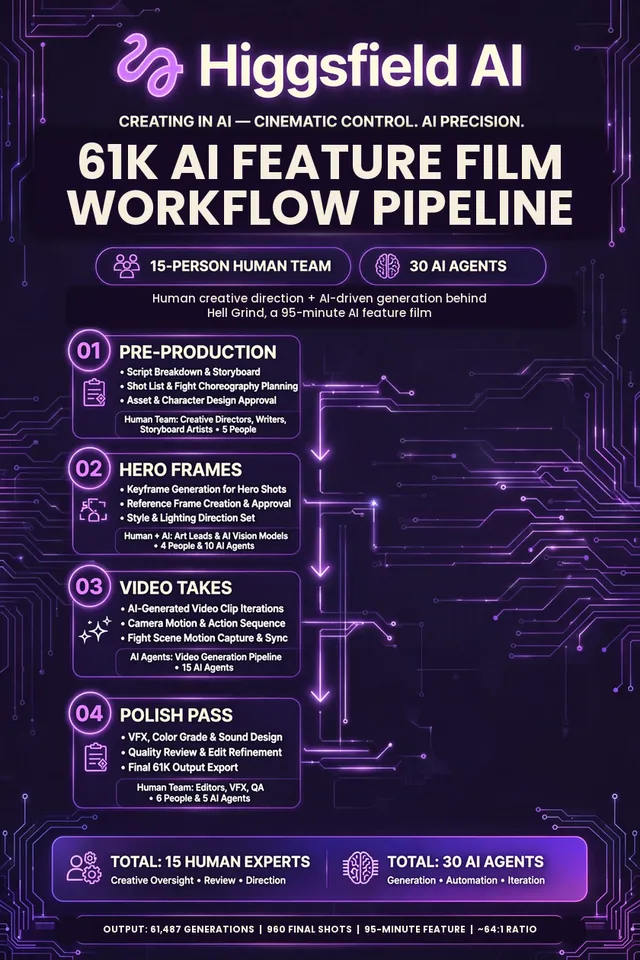
Your AI clips look great on their own, so why does every scene fall apart? These five charts break down how the team behind Hell Grind, a 95-minute AI feature made from 61,487 generations, kept faces, locations, and light consistent from shot to shot.
Sound familiar?
- Your shots look incredible for four seconds and fall apart on the fifth.
- You know what an 85mm close-up does to a reaction. You don't know what to type to get one.
- Every tutorial is either a prompt list with no craft behind it, or craft from someone who's never shipped a frame.
What's inside
- The production pipeline
- The four stages a long-form AI film moves through, and who handles what.
- Character consistency
- The four steps that lock a face before you generate a single shot.
- Long-form assembly
- Five blocks, with the last-frame-to-first-frame handoff that holds the look together.
- The four-beat shot structure
- Establish, attack, react, finish, with the lens for each beat.
- The virtual camera rig
- Real fields of view, f/2.0 to f/8, camera moves, and the speed ramp.
Who it's for
- You've worked in film, TV, or broadcast and you're sizing up whether AI video is real yet
- You can read a shot list and a lens chart without anyone explaining them
- You want to see the actual workflow before you spend a dollar or a weekend on it
- Not for you if you want a one-click prompt that makes a whole film. That doesn't exist.
Where should we send it?
Made by Sean Dinwoodie: 30+ years producing and directing film and TV, now building AI films with the same crew discipline.